

You just need to look at a world map.
It would save you countless hours of propaganda on media of all kinds.
The world map will tell you that the energy of Middle East passes through three main seaborne chokepoints: Strait of Hormuz (Persian Gulf), Bab al Mandab (Red Sea) and Suez Canal.
That energy (i) is one side of power, the other side is sea routes (ii) and blessed is the one which has a dominant say on both the matters.
(i) Energy Side
The matter of energy was hijacked by OPEC in 1960. If the world can’t run without energy, the best way to leverage it is by producing less—and not more—fuel.
The lesser the oil in the market, the higher would be the price. Hence OPEC was a cartel initially created by five countries which, at the start of 2026, had expanded to 12 nations.
Thus every OPEC country was given a quota. They all produced less than what they could. Saudi Arabia, UAE etc didn’t produce more than 70 or 80 percent of its capacity.
Now the UAE has broken free: Ostensibly it could sell twice the capacity it has been restricted to by OPEC’s norms.
This could break up OPEC.
For UAE has sparked a competition amongst its OPEC brethren.
You can’t command a price of your own choice if the other party — in this case UAE — is willing to sell for less.
(ii) Sea Routes
Now reduced production of oil is one mechanism of making money. Another tool is how much risk insurance premium could be raised. For if there is a threat in navigating through the sea chokepoints, the insurance company would jack up the price.
Better still, if oil producers and insurance company could work in tandem — that is there is time-to-time heckles on security of sea lanes, both oil and insurance prices could hit the roof.
So if OPEC was the cartel of oil-producing nations, the insurance was completely in the hands of Lloyd’s insurance company in London. The risk premium through these sea lanes for not last 100, 200 or 300 but 337 years running has been the monopoly of Lloyd’s of London.
If you are sitting in Lloyd’s high-chair and surveying the map, your best bet is if there is volatility in Strait of Hormuz, Red Sea and Suez Canal for then risk insurance could jump manifold.
Iran turned out to be a perfect fit in this enterprise. It could directly close Strait of Hormuz, its proxy in Houthis in Red Sea could do the same, and another proxy in Hezbollahs in Lebanon could keep the sea lanes turbulent. That’s windfall for any insurance company, in this case, it being Lloyd’s of London.
So if Iran could be funded, and funded enough for it to raise its proxies in the Middle East, one could be in the driver’s seat.
There is circumstantial evidence that Iran and City of London were together in bed in this game.
For example, the United Kingdom has imposed 550 sanctions on Iran. Yet Iran’s now dead Ayatollah Khamanei, and his surviving son Mujtaba, have an eye-popping real estate empire in London.
Secondly, now that the US president Donald Trump has looked to flip this decades long manipulation, he sought the help of the United Kingdom to help subdue Iran. The United Kingdom not only bluntly refused, it also didn’t allow the US fighter jets to take off from Diego Garcia air-strips.
Modi’s Move
Donald Trump, during his first term, decided to free the Middle East from this anarchy and thuggery. He created Abraham Accord in 2021 which led to normalisation agreements between a few Gulf States and Israel.
In 2022, I2U2 group was formed comprising India, Israel, UAE and the United States.
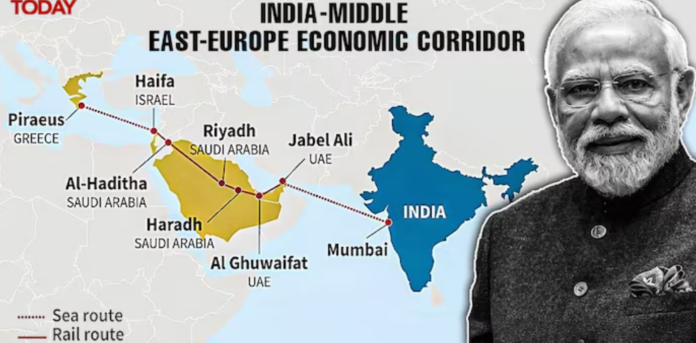
Next year, during the G20 meeting in New Delhi on September 12-13, 2023, Indian prime minister Narendra Modi unveiled IMEC (India-Middle East-Europe Corridor) which linked Mumbai to Saudi Arabia through sea route. Within the desert kingdom, a railroad would then traverse across its length to north to Haifa port in Israel from where the sea trade with Europe would happen.
It upset Hamas. Within five days, Its leader Yahya Sinwar declared that normalization of Israel with Arab nations must be stopped. In less than three weeks, on October 7, 2023, Hamas’ operatives had run riot within Israel, killing and capturing hundreds of Jewish citizens. It put Abraham Accords and IMEC in cold storage.
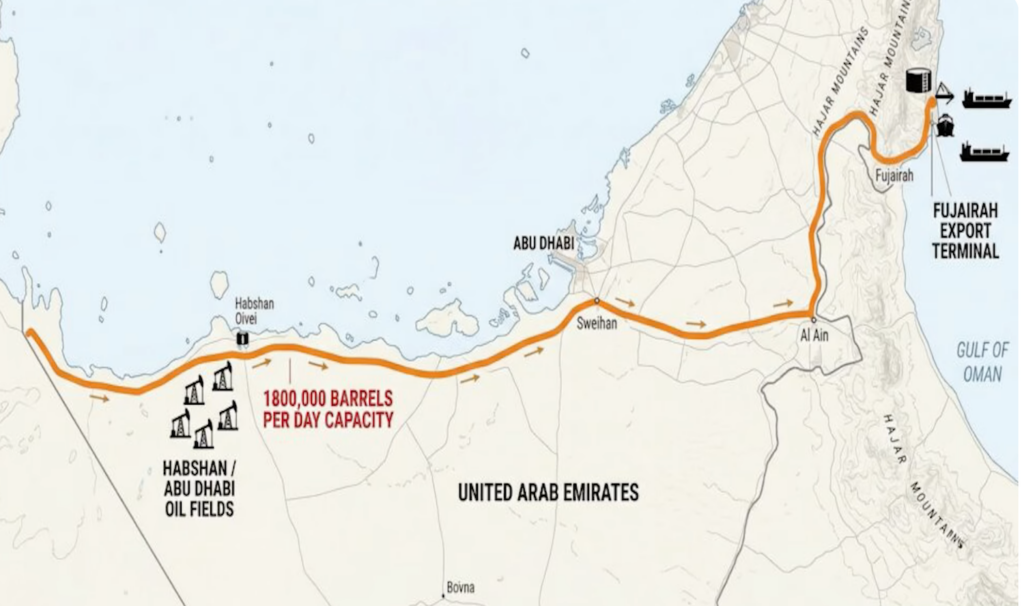
But Gulf nations all along were desperate to break-free of Iran and its proxies’ terror. UAE thus created transport for its oil to reach Fujairah port beyond the reach of Strait of Hormuz in Persian Gulf.
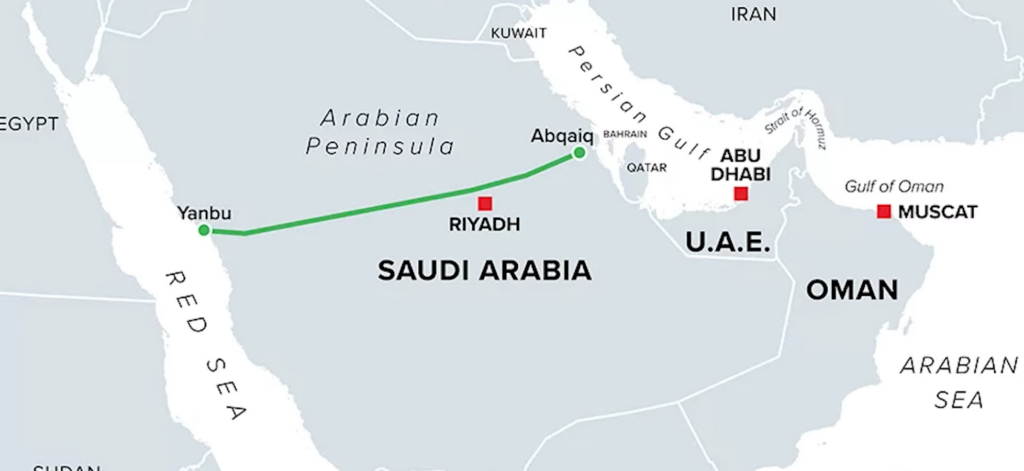
Saudi Arabia, on its part, created a pipeline connecting the Persian Gulf and Red Sea. Its port in Red Sea, Yanbu, had put itself beyond the reach of Houthis.
This Iran War has shown clearly why these alternative sea routes, away from chokepoints in Strait of Hormuz and Red Sea, upsets Tehran greatly.
That’s why one has seen many times how Fujairah and Yanbu have suffered Iran’s missile attacks.
IRGC couldn’t allow the world to have alternative sea routes away from Red Sea and Persian Gulf.
Trump wants this chaos and anarchy be over in the Middle East.
Iran can’t be allowed to hold the world to ransom.
And that Iranians too should be freed from the tentacles of Islamic orthodoxy.
Trump has all but crippled – politically, militarily and economically— Iran in last two months.
The entrenched interests in Tehran are hoping against hope they would wait out Trump.
If Tehran remains stubborn, it would pay a bigger price than what Trump is offering at the moment.